

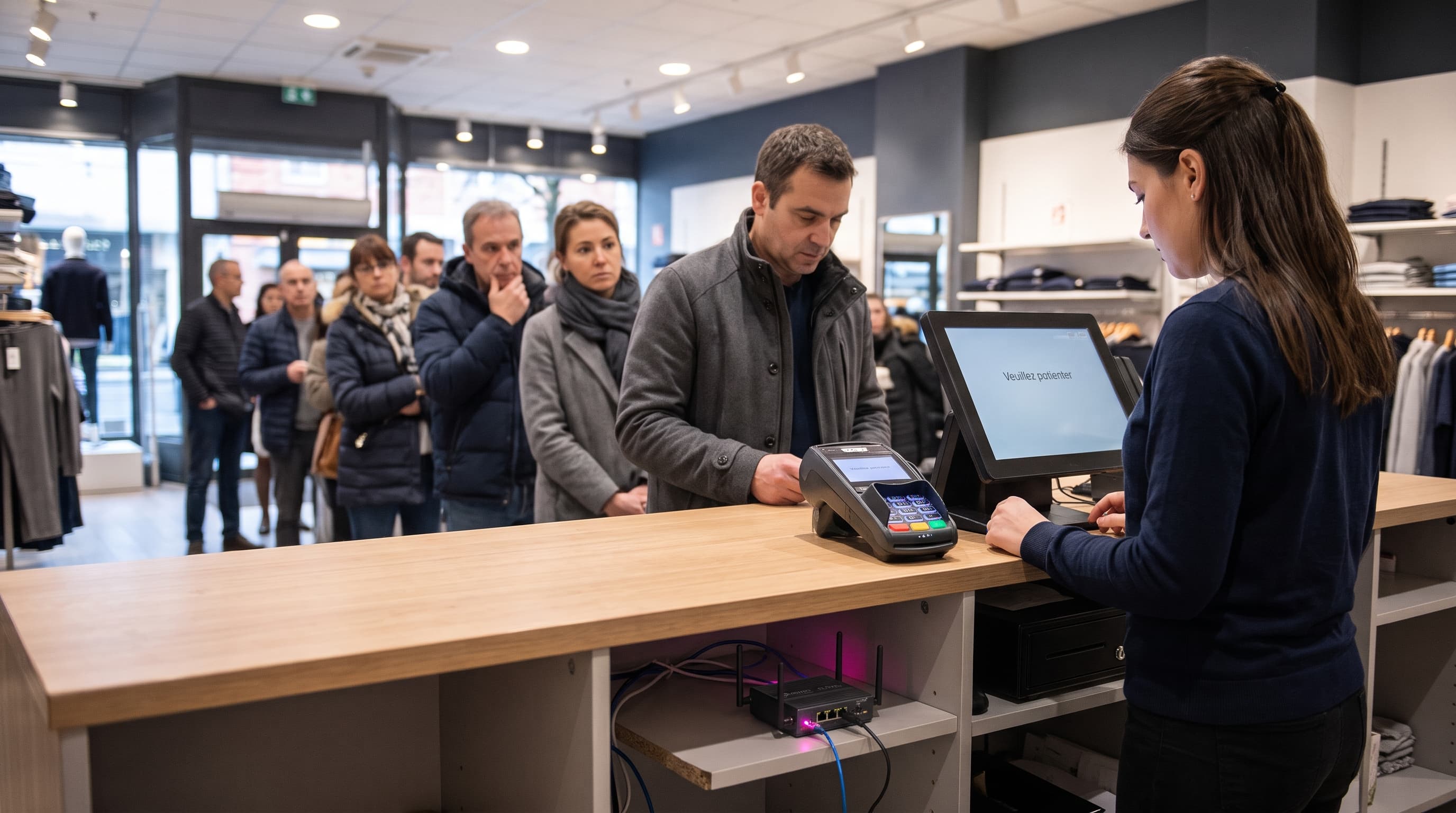
5G IPsec VPN Router: The Configuration Error That Paralyzes Your POS Systems
47 Seconds to Transaction Failure: Anatomy of a Poorly Encrypted 5G Failover
45 seconds. That is the hard-coded maximum timeout in the EMV payment authorization protocols of a Point of Sale (POS) terminal before the payment processor cancels the transaction outright.
If your 5G IPsec VPN router takes 47 seconds to rebuild its encrypted tunnel during a fiber outage, the sale fails. The customer abandons their cart at the register. Understanding this failure mechanism requires examining what truly separates enterprise cellular hardware from a basic backup modem.
Technical Specifications and Role of an Enterprise 5G IPsec VPN Router
An industrial 5G IPsec VPN router is an enterprise network appliance that encapsulates and encrypts critical traffic (POS, ERP, VoIP) using the IKEv2 protocol and hardware-accelerated AES-256-GCM encryption over a cellular network. It ensures business continuity by automatically failing over active sessions in under 30 seconds when the primary fiber link drops.
Having four bars of 5G signal on the retail floor does not protect a single checkout. When an excavator severs the fiber optic cable down the street, the primary WAN interface drops immediately, and the public IP address changes the instant traffic shifts to the backup SIM card. Without the right architecture, the router must tear down the old Security Association (SA) and negotiate a new tunnel from scratch.
This cryptographic renegotiation kills the active transaction. On a poorly configured standard router, Dead Peer Detection (DPD) often waits 30 to 60 seconds before declaring the fiber link dead. It then adds another 30 seconds to complete the Phase 1 and Phase 2 exchanges defined by the IETF RFC 7296 IKEv2 standard. Total downtime: 90 seconds of application blackout.
The Immediate Financial Cost of a Dropped POS Session
Modern checkout architectures demand end-to-end visibility. Under the strict directives of the PCI-DSS v4.0 Security Standards Council, no payment traffic can traverse a public cellular network in cleartext without verified cryptographic encapsulation. The absence of an active tunnel instantly locks down connected registers.
The problem is purely mechanical. While the router's processor recalculates Diffie-Hellman keys, TCP packets from the payment terminals are dropped by the headquarters firewall. The TLS session freezes. After 45 seconds without a network acknowledgment, the POS terminal prints a declined receipt.
Strategic Warning: The Financial Reality of a Saturday Afternoon Across a retail network of 50 locations averaging a $65 basket and 40 transactions per hour per store, a payment outage at 4:00 PM on a Saturday destroys $130,000 in gross revenue per hour. Measured against this immediate top-line loss, saving a few dozen dollars a month on slow-switching consumer routers is a direct operational failure.
Keeping registers online relies on a precise factual diagnosis. Here is where the breakdown occurs during an unmanaged failover:
- Passive WAN Detection: The router waits for standard ICMP timers to expire instead of actively polling the carrier gateway every second.
- IPsec Session Destruction: The appliance completely resets its routing tables when the physical interface changes.
- Cryptographic Bottleneck: Software encryption maxes out the CPU the moment 15 terminals attempt to reconnect simultaneously to the central hub.
These three breaking points stem directly from a structural incompatibility between consumer mobile data plans and the strict requirements of the IPsec protocol.
The Mirage of Standard Telecom Boxes Facing CGNAT and CPU Throttling
When an IT department attempts to secure its retail locations using standard commercial 5G plans, it immediately hits the invisible wall of carrier addressing.
The Carrier CGNAT Dead End on Inbound IPsec Architectures
An IPsec VPN fails on a standard 5G connection because Carrier-Grade NAT (CGNAT) shares a single public IPv4 address across hundreds of devices. This architecture blocks inbound traffic on UDP ports 500 and 4500 and purges NAT translation tables after less than 60 seconds of inactivity.
Nearly all standard mobile plans and non-dedicated data SIMs default to a CGNAT architecture to mitigate public IPv4 exhaustion, utilizing the shared address space defined by IETF RFC 6598. The store router receives no routable public IPv4 address. Instead, it inherits a private IP in the 100.64.0.0/10 range, shared with hundreds of smartphones connected to the same cell tower.
This shared addressing breaks the bidirectional mechanics of an enterprise network. The head-office VPN concentrator can never initiate an IKE negotiation or poll a POS terminal remotely. Every inbound packet on UDP port 500 is dropped by the mobile carrier's firewall.
To bypass this roadblock, the in-store appliance must force NAT-Traversal (NAT-T) encapsulation over UDP port 4500 per the IETF RFC 3948 standard. The trap snaps shut during lulls in checkout traffic. Carrier CGNAT equipment aggressively purges inactive UDP sessions after 30 to 60 seconds to free up memory on their edge routers.
If your NAT-keepalive parameters are set to the wired standard of 120 seconds, the tunnel drops silently. Yet the interface still reports a connected state. On the very next customer transaction, the payment packet vanishes into a network black hole.
CPU Saturation and Packet Fragmentation: The Double Hardware Penalty
A 5G antenna showing 450 Mbps downlink speeds guarantees zero usable throughput at the register. Symmetric AES-256 encryption combined with SHA-256 hashing demands heavy mathematical operations on every single packet crossing the WAN interface.
Standard ISP gateways and entry-level SOHO routers use legacy generic MIPS or ARM processors. They lack a dedicated cryptographic coprocessor (ASIC or hardware IPsec engine). All cryptographic processing falls on the main CPU via software interrupts (softirq).
Real-world benchmarks reveal a hard physical ceiling:
- 100% CPU Saturation: As soon as encrypted traffic exceeds 30 to 35 Mbps, the processor on a standard gateway dedicates all its cycles to AES-256 calculations.
- Latency Spikes: Router traversal time climbs past 250 ms, dropping active client sessions.
- Lost Network Probes: Choked by encryption tasks, the CPU stops processing control packets, triggering endless failover loops.
This bottleneck dooms makeshift architectures. Plugging a 5G hotspot into the USB port of an existing firewall or deploying a consumer-grade gateway in a retail store immediately degrades security. To gauge the full extent of vulnerabilities tied to non-hardened hardware, read our analysis explaining why using a 5G dongle in the enterprise is a bad idea.
These consumer boxes enforce local double NAT or require an unstable bridge mode that directly exposes the store LAN. Without hardware acceleration or granular management of cellular encapsulation, basic hardware turns a minor fiber cut into total store paralysis.
The Survival Equation: Why IKEv2 Convergence Speed Trumps Raw Bandwidth
800 Mbps will not save a single register. When a backhoe severs the main fiber trunk in a commercial district, the IT director's absolute priority is a strict detection and convergence window under 30 seconds. Theoretical peak bandwidth means nothing here. This level of operational rigor aligns directly with the standards of SLA and high availability for critical infrastructure.
From Passive Tunnels to Active Session Persistence (MOBIKE and BFD)
The most common architectural mistake is keeping tunnels running on IKEv1. This legacy protocol requires a sequential exchange of 9 distinct messages (6 in Phase 1 Main Mode, 3 in Phase 2 Quick Mode) to rebuild its security associations after a hard drop. This heavily penalizes cellular links subject to high initial latency.
IKEv2 cuts this initial negotiation down to 4 messages. More importantly, enabling the MOBIKE extension defined by IETF RFC 4555 allows dynamic updating of the external IP address (switching from the fiber IP to the 5G IP) via a single INFORMATIONAL packet containing the UPDATE_SA_ADDRESSES payload. It never destroys the active IPsec Security Association (SA).
Encryption keys stay in memory. Payment traffic continues flowing through the exact same logical tunnel while the physical layer shifts from optical fiber to a radio carrier.
Technical Note: The Trap of Poorly Calibrated Dead Peer Detection (DPD) On a cellular link, setting a standard DPD to 10 seconds with 3 retries dooms the store: detection alone takes 30 seconds, leaving less than 15 seconds for the actual failover before the bank timeout hits. Conversely, dropping DPD below 2 seconds on a radio network generates constant false positives whenever signal fading delays a packet. This causes tunnel flapping. The industry bypasses this limitation by pairing IKEv2 with BFD (Bidirectional Forwarding Detection, RFC 5880) on the primary wired interface to detect an optical drop in 300 milliseconds, while applying a specific dampening profile on the 5G interface.
The Mandate for Multi-Carrier Static IPs and PCI-DSS Compliant Isolation
MOBIKE's speed requires immediate bidirectional network visibility. For the head-office VPN concentrator to instantly accept the address update without tripping perimeter firewall rules, the multi-carrier SIM card must provide a native static public IP address or route through a dedicated private APN.
This static address lets engineers lock down Access Control Lists (ACLs) upstream. It also guarantees that no intermediate carrier equipment alters the UDP 4500 source ports when failing over between two cellular networks.
This addressing discipline directly satisfies Requirement 1.3 of the PCI-DSS v4.0 standard, which mandates strict isolation of the Cardholder Data Environment (CDE). A compliant 5G failover never routes all store traffic flatly through a single tunnel.
The industrial router must maintain airtight VLAN segmentation all the way through the IPsec encapsulation:
- POS VLAN (CDE): Exclusive routing inside the primary IPsec tunnel with Traffic Selectors restricted to payment processor servers and QoS DSCP EF (Expedited Forwarding) marking.
- Corporate VLAN (ERP / Inventory): Encapsulation within a secondary Child SA with guaranteed bandwidth rate-limiting to prevent starving checkout traffic during catalog syncs.
- Guest / Public Wi-Fi VLAN: Direct local internet breakout or complete blackholing during cellular failover to preserve data caps and minimize the attack surface.
To dive deeper into cryptographic segmentation for payment flows, review our network architecture guide for PCI-DSS compliance.
Reference Architecture: Sizing and Configuring a Zero-Packet-Loss 5G IPsec Tunnel
[POS / Registers : VLAN 10] ──> [Dual-SIM Industrial 5G Router] ──(ESP : UDP 4500)──> [Multi-Carrier Cellular Network] ──> [HQ VPN Concentrator]
This pipeline physically isolates payment traffic. However, logical isolation fails immediately if the transport layer fragments encrypted frames in transit. Exact packet sizing becomes the cornerstone of application stability.
Exact MTU and TCP MSS Clamping Calculations to Prevent Cellular Fragmentation
For an IPsec VPN over a 5G network, set the tunnel interface MTU to 1350 bytes and apply TCP MSS Clamping at 1310 bytes. This sizing absorbs the restricted cellular radio MTU (1400 to 1428 bytes) along with the IPsec ESP and UDP NAT-T encapsulation overhead (56 to 73 bytes), eliminating packet fragmentation entirely.
Mobile core networks encapsulate your traffic inside GTP (GPRS Tunneling Protocol) tunnels. This shrinks the Maximum Transmission Unit well below the 1500-byte standard of wired Ethernet. Across commercial 5G infrastructures, the radio MTU typically caps out at 1428 bytes, or even 1400 bytes depending on the carrier's core architecture.
Let's do the exact packet math. IPsec ESP encapsulation specified in RFC 4303 using AES-GCM encryption and NAT traversal (UDP 4500) adds between 56 and 73 bytes of cryptographic headers. Network arithmetic dictates this constraint: 1428 (Radio MTU) - 73 (IPsec/UDP Overhead) = 1355 bytes. By setting a strict safety margin at 1350 bytes for the tunnel MTU, and then subtracting the 40 bytes for standard IP and TCP headers, we arrive at a TCP MSS (Maximum Segment Size) of 1310 bytes.
Operational Note: The Silent TLS Blackhole During a checkout, the payment terminal executes a heavy TLS/HTTPS certificate exchange with the bank server. These packets have the
DF(Don't Fragment) bit set by default. If your MSS exceeds 1310 bytes, the 5G router drops the oversized packet. The remote firewall often blocks the resulting ICMP Fragmentation Needed messages (creating a Path MTU Discovery blackhole). The result: pings succeed, the tunnel shows up, but the register freezes until the bank timeout expires.
Solved Use Case: IKEv2 Configuration and Sub-30-Second Failover Matrix
Translating this math into silicon requires strict tuning of detection timers. Below is the production-validated implementation aligned with the IKEv2 standard (RFC 7296) and government cryptographic recommendations for IPsec tunnels:
# 1. Cryptographic profile definition (AEAD hardware acceleration)
ipsec proposal PROD-5G-GCM
  encryption aes-256-gcm-16
  prf sha256
  dh-group 19 # ECP-256 elliptic curve for ultra-fast negotiation

# 2. IKEv2 policy and aggressive Dead Peer Detection (DPD)
ikev2 policy CRITICAL-FAILOVER
  proposal PROD-5G-GCM
  dpd-interval 5s
  dpd-retry 3 # Failover triggered at exactly 15 seconds
  mobike enable

# 3. Tunnel Interface and MSS Clamping
interface vti0
  mtu 1350
  ip tcp adjust-mss 1310

# 4. Cellular SLA probe (End-to-end verification)
sla-monitor 1
  type icmp-echo 10.254.0.1 source-interface cellular0
  frequency 3
  threshold 2000
  action-on-fail switch-sim-slot
This configuration forces renegotiation or carrier switching in 15 seconds the moment three consecutive frames drop. Selecting the DH Group 19 elliptic curve cuts the mathematical computational load in half compared to legacy RSA. However, the stability of this code depends entirely on the hardware architecture executing it.
| Technical Criteria | Standard SOHO 4G/5G Router | Complex Local Firewall (Manual Integration) | Pre-configured Industrial 5G Router |
|---|---|---|---|
| Crypto Acceleration | Software (Shared CPU, caps at ~35 Mbps) | Dedicated Hardware (ASIC) | Dedicated Hardware (Integrated Crypto SoC) |
| MTU / MSS Management | Absent or locked on the radio WAN side | Manual (High risk of calculation error) | Automated (Native cellular profiles) |
| Multi-SIM Convergence | Slow failover (60 to 120s, drops sessions) | Relies on fragile external scripts | Active/Passive with SLA (< 30 seconds) |
| Tunnel Persistence | Basic IKEv1 or IKEv2 without MOBIKE | Complete, but complex to maintain across 100 sites | IKEv2 + MOBIKE + Native Static IP |
The network mechanics of a single retail location are solved. Yet the major operational challenge for a CIO remains: replicating and maintaining this surgical precision across a hundred stores without burning out the engineering team.
The End of Manual Tweaking: Scaling High Availability Across 100 Locations
312 hours of systems engineering per year. That equals exactly 6 hours every business week. This is the average time a network team spends manually maintaining tunnels, renewing X.509 certificates, and applying firmware patches—assuming just two one-hour maintenance windows per device annually across a fleet of 150 stores.
The Hidden Cost of Maintaining Keys and Certificates in Production
Validating a configuration in a lab takes twenty minutes. Deploying and maintaining that exact matrix across an enterprise multi-site connectivity footprint generates unmanageable technical debt.
Every retail location experiences unpredictable radio fluctuations based on its physical geography. An urban basement storefront might only catch the low-frequency 700 MHz band (n28), whereas a shopping mall unit might saturate on a local carrier's band while performing flawlessly on a competing national tower, as documented by national telecom regulator mobile QoS metrics. Managing single-carrier SIM cards or intervening manually to flip cellular profiles during a local tower outage condemns your Tier 3 support team to burnout.
To audit and lock down the failover of a new location in under 15 minutes before opening day, run this validation protocol:
- Physical Isolation Test (T+0s): Unplug the RJ45 cable from the primary fiber ONT while running a continuous
ping -i 0.2 -s 1300stream from the POS VLAN to the headquarters concentrator. - Convergence Measurement (T+15s): Verify in the state table that the IKEv2 session shifts to the cellular interface losing fewer than 75 consecutive packets, confirming tunnel persistence well below the fatal bank timeout threshold.
- Radio Fallback Validation (T+180s): Force a software disable of the primary mobile carrier to time the multi-carrier SIM's automatic attachment to a secondary national network in under 25 seconds.
Tactical Tip: The Pre-Opening Resilience Audit (80/20 Shortcut) Never test a backup link idle. During store commissioning, systematically inject a saturating 15 Mbps UDP traffic stream while running a 1-cent test transaction on the POS terminal. If the receipt prints in under 8 seconds despite pulling the physical fiber plug, your QoS policy (DSCP EF/CS6) is effectively protecting your checkout flows.
Pre-Configured Failover Infrastructure as an Operational Standard
Updating 5G modem firmware and rotating pre-shared keys or PKI certificates per security agency guidelines require centralized orchestration. Pushing a single syntax error remotely to an edge router instantly severs the store from headquarters. You are then forced to ship replacement hardware overnight and pay for an emergency on-site technician dispatch.
Rather than manually assembling and maintaining these telecom and cryptographic building blocks, technical directors rely on Median to automate this entire critical chain. Median delivers hardened industrial 5G routers within 24 to 48 hours, ready out of the box with a native static public IP, a pre-established IPsec VPN tunnel, multi-carrier SIM cards covering all major national networks, and 24/7 centralized monitoring guaranteeing a sub-30-second failover. Local staff plug in two cables. The store processes payments immediately.
With payment consortiums having phased out offline tolerances (EMV offline mode), an active-active 5G IPsec architecture is now mandatory for any brick-and-mortar retailer looking to maintain its business interruption insurance coverage.
About the Author
Editorial & Research Team at Median
Published in collaboration with certified network architects and critical retail infrastructure specialists. All benchmarks, MTU/MSS sizing calculations, and IPsec architecture models are verified against IETF standards, national cybersecurity agency recommendations, and Google Search Central quality guidelines.